


How to Build a Profitable Web Hosting Business Using Reseller Hosting

Starting a web hosting business may sound complicated if you imagine buying servers, maintaining infrastructure, and handling every technical issue yourself. However, reseller hosting business opportunities offer a simpler route for freelancers, web designers, developers, and small digital agencies that want to add hosting services to their business.
The basic idea is straightforward: you rent hosting resources from an established provider, divide them into customer accounts, and offer those services under your own business brand. You remain responsible for your customers and service experience, while the underlying server infrastructure is handled by the hosting provider.

What Makes Reseller Hosting a Practical Business Model?
Think of reseller hosting like renting space in a commercial building and then managing individual offices for your clients. You do not have to construct the building yourself, but you still decide how the available space is organized and who uses it.
A reseller hosting account works in a similar way. You receive a defined amount of hosting resources and can create individual hosting accounts based on your customers' requirements.
This model can work particularly well for businesses that already provide:
Website design
WordPress development
Website maintenance
Domain services
Business email setup
SEO services
Digital marketing
IT support
Instead of sending clients to another company for hosting, you can make hosting part of your existing service portfolio.
Start With Your Customers, Not Your Hosting Package
One of the easiest mistakes to make is choosing a reseller plan before understanding who you intend to serve.
Start by defining your target customer. A freelancer serving small business websites will have different requirements from an agency managing large e-commerce websites.
Consider these questions:
How many customers do you expect during the first year?
What types of websites will they operate?
How much storage might those websites require?
Will customers need email accounts?
Will you provide technical support?
Will hosting be sold separately or included with another service?
Answering these questions gives you a clearer idea of how many resources you actually need.
For example, a designer working with local restaurants may have several small websites that use relatively modest resources. Buying a very large hosting allocation at the beginning may not make sense if most of the available capacity will remain unused.
Understand Resource Allocation
Resource allocation is one of the most important parts of running a reseller hosting service.
Your reseller account may provide resources such as storage, bandwidth, databases, email capacity, and other limits. You then distribute those resources among individual customer accounts.
Think of your available resources as a monthly budget. If you give one customer an unnecessarily large portion of that budget, you have less flexibility for everyone else.
A simple starting approach could involve three packages:
Package | Typical Customer | Resource Level | Main Purpose |
Starter | Small business website | Basic | Entry-level hosting |
Business | Growing website | Medium | General business use |
Professional | Resource-heavy website | Higher | Larger websites |
The actual limits should always match the resources available in your reseller account. Avoid promising resources that your hosting environment cannot reliably provide.
Create WHM Packages That Are Easy to Understand
WHM, or Web Host Manager, is commonly used to manage hosting accounts in reseller environments that support it.
You can use it to organize different hosting packages and assign appropriate limits to customer accounts. You do not need to understand every setting immediately. Focus first on the options that directly affect the services you intend to sell.
For example, you might create:
Starter Hosting
Designed for a basic business website, portfolio, or small blog.
Business Hosting
Designed for businesses that need more website space, email accounts, databases, or other resources.
Professional Hosting
Designed for customers whose websites require a larger resource allocation.
Keep package names and descriptions simple. Customers generally care more about what they can do with a package than about technical terminology.
Build a White-Label Hosting Service
A major attraction of reseller hosting is the ability to build a customer-facing service around your own business identity, depending on the features offered by your provider.
Your website can present the hosting packages using your own:
Business name
Logo
Brand colors
Package descriptions
Support contact details
Billing information
The goal is not to hide the underlying infrastructure through misleading claims. Instead, it is to create a consistent customer experience where clients know who they are purchasing the service from and who to contact for assistance.
Before choosing a reseller provider, check exactly which white-label and branding options are included in the plan.
Example: A Freelance Web Designer Adds Hosting
Imagine a freelance web designer who creates websites for local restaurants and small retailers.
A client may initially approach the designer only for a website. After the project is completed, the client still needs hosting, domain management, SSL configuration, and occasional website support.
The designer can offer hosting as an additional service through a reseller account. The client gets a single point of contact, while the designer avoids having to operate physical servers.
This creates a natural connection between website development and hosting without requiring the designer to become a data-center operator.
Set Up a Clear Client Billing Process
Hosting is usually a recurring service, so billing needs more attention than a one-time website project.
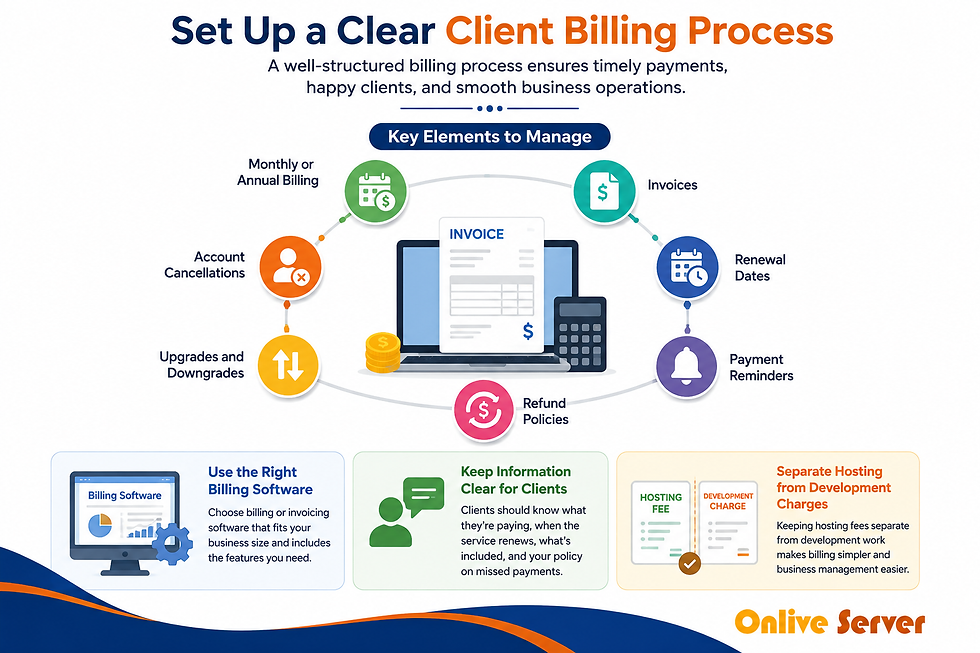
Before taking on customers, decide how you will manage:
Monthly or annual billing
Invoices
Renewal dates
Payment reminders
Account cancellations
Upgrades and downgrades
Refund policies
You can use suitable billing or invoicing software based on the size of your business and the features you require.
Keep the customer-facing information clear. A client should know how much they are paying, when their service renews, what is included, and what happens if payment is not received.
Separating hosting fees from website development charges can also make your business easier to manage.
Choose Pricing Based on Your Real Costs
Pricing your hosting service simply by looking at competitors can create problems.
First calculate your own operating costs. These may include the reseller plan, payment processing, billing tools, support time, domain-related services, and other business expenses.
Then decide how much margin you need to make the service worthwhile.
For businesses comparing different entry-level options, researching cheap reseller hosting plans can help clarify the type of resources and features that may be available at different price levels.
The goal should not be to become the cheapest provider. A sustainable service needs pricing that covers its costs while giving customers a clear reason to choose it.
Use Existing Services to Find Your First Customers
You do not need to market your hosting service to everyone.
Your existing customer base may be the most logical place to begin. If you already design websites, maintain WordPress sites, or provide digital services, those clients already have a reason to need hosting.
Other potential customer sources include:
Local businesses
Freelance clients
Small agencies
Developers
Business communities
Professional referrals
Website maintenance customers
You can also publish educational content that answers common hosting questions. Helpful articles about domains, SSL, website speed, backups, email, and hosting management can attract people who are researching these topics.
For additional ideas about developing this type of service, you can read this resource on how to grow a reseller hosting business.
Keep Track of Resource Usage
As your customer list grows, monitor how resources are being used.
A small number of websites may consume significantly more resources than the others. Large media libraries, poorly optimized websites, traffic spikes, or resource-heavy applications can affect the amount of capacity an account needs.
Regular monitoring helps you identify when a customer needs a different package.
It also helps you understand whether your original package structure still makes sense. If most customers use only a small portion of the resources assigned to them, you may need to reconsider how your packages are designed.
Common Mistakes to Avoid

1. Buying More Resources Than You Need
A larger reseller account is not automatically a better starting point. Estimate your initial customer requirements before committing to a resource level.
2. Creating Too Many Hosting Plans
Ten similar packages can make purchasing confusing. Start with a few clearly differentiated options and adjust them as customer needs become clearer.
3. Competing Only on Price
Low pricing may attract attention, but it does not automatically create a sustainable business. Consider support, service quality, reliability, and the actual resources included.
4. Promising Unlimited Support
Hosting customers may ask for website changes, coding help, email troubleshooting, or other tasks. Define what your hosting support covers and charge separately for development work when necessary.
5. Ignoring Renewal Dates
A missed renewal can create unnecessary service interruptions. Maintain accurate billing records and communicate renewal information clearly.
6. Overlooking Customer Security
Customers should understand the importance of strong passwords, software updates, backups, and secure website administration. Reseller hosting does not remove the customer's responsibility for everything running inside their account.
Frequently Asked Questions
Q. Is reseller hosting good for beginners?
A. It can be a practical option because you do not need to operate physical server infrastructure yourself. Beginners can concentrate on learning account management, customer support, billing, and basic hosting concepts.
Q. Do I need technical knowledge to start?
A. Basic hosting knowledge is useful, but you do not need to be an infrastructure expert before starting. You should understand the services you sell and know when an issue needs to be escalated to your hosting provider.
Q. Can I use my own business name?
A. Many reseller plans provide white-label or branding options, but the exact features vary between providers. Always check the plan's branding capabilities before making a decision.
Q. How many customers can I host?
A. There is no fixed number that applies to every reseller account. The practical capacity depends on your available resources and how much each customer's website uses.
Q. Can web designers become hosting resellers?
A. Yes. Web designers and agencies can combine hosting with website development and maintenance services. This can make hosting a natural extension of their existing work.
Q. What should I include in a reseller hosting package?
A. Start with the resources your target customers actually need. Storage, bandwidth, databases, email, control panel access, and support terms are some areas you may need to define.
Q. What if a customer needs more resources?
A. You can review whether a larger package or another hosting environment is appropriate. The decision should be based on the customer's actual application and resource requirements.
Conclusion
Reseller hosting business opportunities can provide a practical starting point for people who want to build a hosting service without managing physical server infrastructure themselves.
The strongest approach is to start with a clear customer group, allocate resources carefully, create simple hosting packages, establish reliable billing, and provide clear support boundaries. As your customer base grows, you can use real usage patterns to refine your packages and infrastructure requirements.
If you are considering this business model, researching cheap reseller hosting plans can be a useful next step for understanding available resources and deciding how a reseller service could fit into your existing business.


Comments